Amanda Pharrell
Crimson LakeAmanda Pharrell is both a convicted killer and a practicing private investigator: the same person whom Crimson Lake township knows through Lauren Freeman’s murder now takes on missing-person cases and helps expose a new crime. Her work with Ted Conkaffey on Jake Scully’s disappearance makes that contradiction active rather than abstract. Amanda’s history shapes how others approach her, but her investigative judgment and persistence also shape what the investigation is able to uncover.
Identity and Public Reputation
After serving ten years in prison for the 2004 stabbing murder of Lauren Freeman, Amanda acquired a private detective’s licence and opened Pharrell Private Investigations on Beale Street. The announcement of her business presented its scope as broad, extending from insurance fraud to murder, and reported that inquiries had already arrived during its first three days. Some district residents objected to the venture, but there were no licensing restrictions preventing her from working. Her public identity is therefore divided between a conviction that remains central to how the community sees her and a lawful occupation that gives her a new role within it.
The small office’s handwritten notice listed its hours as 10 a.m. to 10 p.m. Ted found Amanda there after reading a newspaper article about the agency. Its headline emphasized her conviction, and its account linked her name to the killing of a local teenager. The article’s framing helps explain why the meeting begins under the weight of reputation before either investigator knows the other. Amanda’s work is publicly legible as a provocation to some residents, even while the licensing rules allow it.
Background and the Record of Her School Years
Ted later compares his growing acquaintance with Amanda to accounts of her teenage behavior collected in a book about Lauren Freeman’s murder. Those accounts describe a girl who was quiet and highly intelligent, particularly in written work, but who struggled with group-based and performance tasks. Former classmates reportedly recalled that Amanda sometimes withdrew abruptly from tentative friendships, stopping communication and avoiding contact rather than repairing a social rupture. One teacher’s decision to read Amanda’s essay aloud was said to have ended with Amanda overturning her desk and leaving the room.
The comparison is revealing but not a complete portrait. The book presents the adolescent as difficult to approach, and Ted recognizes in that history a pattern of sudden distance; he is also trying to reconcile it with the investigator he now knows. The analogy to a wary fox comes from the published account’s description of a girl who might briefly approach others before retreating. It frames her social reserve as a recurring feature of how other people interpret her, not as proof that she is incapable of connection or cooperation.
The Lauren Freeman Case
Amanda’s conviction is rooted in her relationship with Lauren Freeman, who was seventeen when she died. On the afternoon in question, Lauren picked Amanda up from school, and the two went to a clearing off the road at Kissing Point in Lauren’s car. The case record described them sitting together for about ten minutes before Amanda attacked Lauren. Amanda admitted the attack at trial and was convicted of the killing. The account establishes that the relationship between the girls ended in violence, while the later article about Amanda’s agency shows how that conviction continues to define her public standing after her release.
The narrative places that past beside Amanda’s present without making the two interchangeable. Her agency’s existence does not erase the conviction, and the conviction does not by itself describe what she does as an investigator. That tension is central to the way her character enters the story: she must work in a community where the most consequential fact about her past is also the fact most likely to precede her into every new professional encounter.
The Agency and Ted Conkaffey
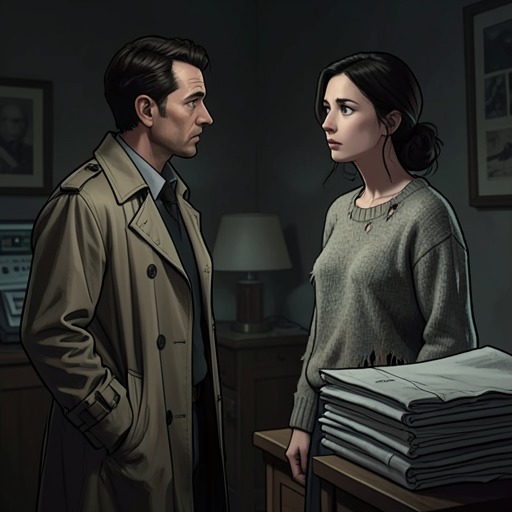
When Ted approaches the office, Amanda does not greet him with an easy handshake. Wearing thick-framed red glasses, she looks him over and indicates that the waitress, Vicky, is his last chance if he is not seeking Amanda. She already knows Sean has referred him, and asks whether he can begin work within the next week or needs the weekend. Ted is surprised to learn that Sean has arranged for him to work for her. Their meeting is brisk and wary: she treats the proposed partnership as practical business rather than offering reassurance or friendship.
Their first major assignment is the disappearance of Jake Scully, a local celebrity. Amanda says that Jake’s wife hired her because she was dissatisfied with the Queensland Police response: three weeks had passed without progress, and she was not being kept informed. The family had money to bring in additional help, and Amanda was willing to take the case. Before Ted can simply plunge into the investigation, Amanda says they must establish ground rules for working together. The terms themselves are not specified in this account, but her insistence makes clear that the partnership is to be organized rather than improvised.
Amanda’s investigative work also draws on knowledge of Jake’s private life. She leads Ted to Samuel Polson, whom she identifies as the Sam associated with a number in Jake’s cigar box and as Jake’s former lover. At the apartment building, Ted observes that Amanda moves with the quiet confidence of an experienced investigator, despite having been at the work for only two years. Her assurance is not presented as omniscience: Ted wonders what cases she has taken, how successful they were, and what mistakes brought her to her current steadiness. The scene instead establishes competence as something she has acquired through practice.
Investigation and Confrontation
Amanda’s work on Jake’s case includes following up an assault at a bookshop on McLeod Street in Cairns, where Jake had given a reading. She tells Ted that she has obtained the police report and that the store’s CCTV has also been emailed to her. The two load the video files and begin reviewing them. The detail matters because Amanda is not relying only on rumor or on the celebrity narrative surrounding Jake: she pursues an incident report and recorded footage as part of the investigation.
Later, Amanda confronts Ormund Smitt about his account of Jake’s writings and the supposed end-times messages in them. Ormund argues that Jake had written about such ideas well before his famous series and that readers overlook the importance of his early online work. Amanda challenges the premise rather than accepting his elaborate interpretation. This exchange shows her as resistant to a suspect’s or witness’s preferred story, even when it arrives wrapped in an extensive theory.
The letters that figure in the investigation eventually lead Amanda to a more direct accusation. In the confrontation with Harrison Scully, she identifies the threatening messages attributed to Ormund as Harrison’s fabrications: she says Harrison made up the material and sent it to his father to make him paranoid. Ted adds that the letters’ carefully constructed fan voice and the information about Jake’s car helped implicate Ormund. Amanda’s intervention is a specific contribution to the case’s resolution: she recognizes that the supposed obsessive fan is not the author of the threats and names the person behind them. Harrison rejects their credibility, invoking Amanda’s conviction and Ted’s accusation as reasons they will not be believed, so her past remains a weapon in the confrontation even as she works to expose his deception.
Narrative Role
Amanda is introduced through the public label of killer, but the investigation repeatedly complicates that label with observable actions: she establishes professional boundaries, follows leads, seeks documentary evidence, and challenges explanations that do not hold together. The contrast does not absolve her of Lauren Freeman’s murder; it prevents that past from serving as a complete account of every role she occupies. In the Jake Scully investigation, she is neither simply the subject of public suspicion nor a sidekick to Ted. She is a partner with her own contacts, methods, and judgments, and her recognition of Harrison’s forged letters helps turn the case away from a misleading story toward the person who constructed it.